Introduction#
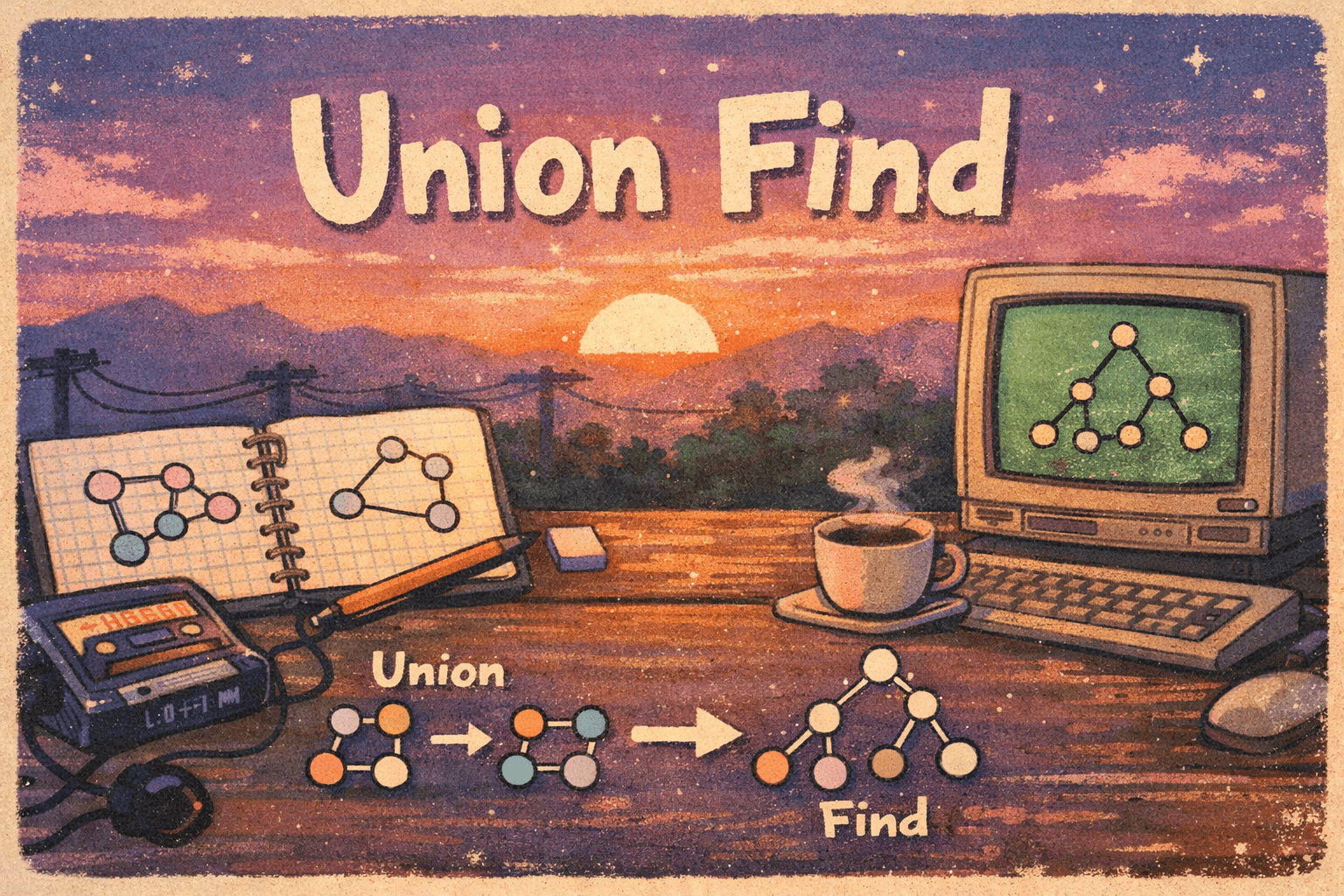
Union-Find, also known as Disjoint-Set Data Structure, is a data structure that helps solve the problem of partitioning a set into disjoint subsets. It provides efficient operations to determine whether two elements belong to the same subset and to merge (or union) two subsets together.
It has 2 main operations:
- find(x): Finds and returns the representative (also known as the root) of the subset to which element x belongs
- union(x, y): Merges the subsets containing elements x and y into a single subset.
Basic version#
class UnionFind:
    def __init__(self, n):
        # 1. Initialization
        self.parent = list(range(n))

    def find(self, x):
        # 2. Find
        # the parent of root node is itself
        if self.parent[x] == x:
            return x
        else:
            return self.find(self.parent[x])

    def union(self, x, y):
        # 3. Union
        parent_x = self.find(x)
        parent_y = self.find(y)
        self.parent[parent_x] = parent_y
- Initialization: Every node is not connected and in its own set, so set the parent to itself.
- Find: recursively find the root of current node. The connected nodes will share the same root.
- Union: Connect 2 nodes together by connecting their roots.
Optimization#
The Basic version has the problem - Trees can become very tall (like a linked list). The Union-Find data structure employs two key optimization techniques: path compression and union by rank.
Path Compression#
Path compression helps flatten the tree structure formed by subsets, reducing the time complexity of subsequent Find operations.
def find_with_path_compression(self, x):
    if self.parent[x] != x:
        self.parent[x] = self.find(self.parent[x])
    return self.parent[x]
Find the root of current node and update the parent of all nodes in the path to the root.
Union by Rank/Size#
Optimization: attach the smaller tree under the larger one.
Two variants:
- Union by size → attach smaller set to larger set
- Union by rank → attach shallower tree under deeper tree
Algorithm Complexity#
Time complexity:
| Implementation | find | union | m operations |
|---|---|---|---|
| Naive | O(n) | O(n) | O(mn) |
| Union by Rank | O(log n) | O(log n) | O(m log n) |
| Path Compression only | ~O(log n) | ~O(log n) | ~O(m log n) |
| Rank + Path Compression | O(α(n)) | O(α(n)) | O(m α(n)) ≈ O(m) |
Space complexity: O(n)
Related questions#
- LC323: number of sets
- count the number of connected component nodes which include node a
- 2d array
- LC827: 2d array + maintain size